2. Stoichiometry calculation and ternary plot of apatite
pyAp allows users to calculate the stoichiometry and mole fractions of components in apatite using functions ApStoic.py and ApStoic_Ketcham.py.
The stoichiometry calculation method was adapted from Ketcham (2015) https://doi.org/10.2138/am-2015-5171
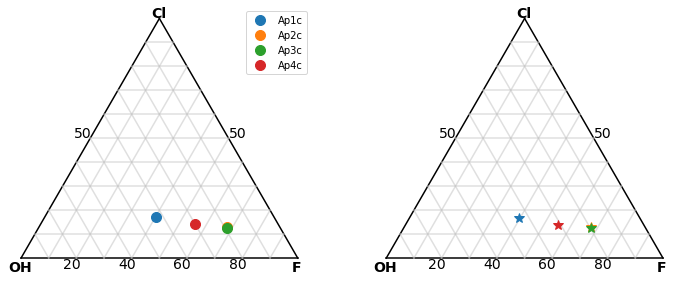
The results can be plotted in the F-Cl-OH ternary diagram by calling functions in ApThernary.py. See an example below.
Import releavant modules and data
Import modules
[1]:
import matplotlib.pyplot as plt, pandas as pd, math

## use the 3 lines below if you want to use the pyAp codes inthe subdirectory next to the current path
## comment them, if you want to use the pyAp installed elsewhere on your computer
import os, sys
if not os.path.exists('pyAp') and os.path.exists('../pyAp'): # hack to allow scripts to be placed in subdirectories next to pyAp:
    sys.path.insert(1, os.path.abspath('..'))

## import pyAp modules
from pyAp.ApStoic import stoi_
from pyAp import ApTernary
from pyAp.ApStoic_Ketcham import stoi_ketcham
Import data
[2]:
data = pd.read_excel('data_ap_major_volatile.xlsx',sheet_name='Sheet2')
Stoichiometry calculation
Use assume_oxy=26 for F- or Cl-apatite; assume_oxy=25 for OH-apatite. The default is 26 if no values are assigned.
[3]:
results_stoi = stoi_(data,assume_oxy = 26)
results_stoi
[3]:
| CA | TI | AL | FE | MG | MN | K | NA | CE | SR | P | SI | S | C | XF | XCL | XOH | stoi_bias,(Ca/P-5/3)/(5/3)*100% | sample | CAL_H2O(WT%) | |
|---|---|---|---|---|---|---|---|---|---|---|---|---|---|---|---|---|---|---|---|---|
| 0 | 10.063423 | 0.0 | 0.0 | 0.046444 | 0.025872 | 0.029399 | 0.0 | 0.037013 | 0.013978 | 0.006038 | 6.064945 | 0.001735 | 0.016931 | 0.0 | 0.400665 | 0.172060 | 0.427275 | 0.816762 | Ap1c | 0.738198 |
| 1 | 9.895894 | 0.0 | 0.0 | 0.046046 | 0.084643 | 0.029146 | 0.0 | 0.003002 | 0.012724 | 0.005986 | 5.995385 | 0.044735 | 0.009942 | 0.0 | 0.680179 | 0.129759 | 0.190062 | -0.059461 | Ap2c | 0.331212 |
| 2 | 9.941816 | 0.0 | 0.0 | 0.046156 | 0.088724 | 0.029216 | 0.0 | 0.026175 | 0.011839 | 0.006000 | 5.981111 | 0.034010 | 0.009779 | 0.0 | 0.682218 | 0.124887 | 0.192895 | 1.079786 | Ap3c | 0.335344 |
| 3 | 9.917455 | 0.0 | 0.0 | 0.046295 | 0.090046 | 0.029305 | 0.0 | 0.024756 | 0.015322 | 0.006019 | 6.016471 | 0.045379 | 0.014583 | 0.0 | 0.559375 | 0.140459 | 0.300166 | 0.017858 | Ap4c | 0.520263 |
Use an oxygen number between 25 and 26 using stoi_ketcham() function in module ApStoic_Ketcham.py
[4]:
results_ketc = stoi_ketcham(data)
results_ketc
[4]:
| CA | TI | AL | FE | MG | MN | K | NA | CE | SR | ... | SI | S | C | XF | XCL | XOH | stoi_bias,(Ca/P-5/3)/(5/3)*100% | sample | CAL_H2O(WT%) | OXYGEN NUMBER | |
|---|---|---|---|---|---|---|---|---|---|---|---|---|---|---|---|---|---|---|---|---|---|
| 0 | 9.894319 | 0.0 | 0.0 | 0.045664 | 0.025437 | 0.028905 | 0.0 | 0.036391 | 0.013743 | 0.005936 | ... | 0.001706 | 0.016647 | 0.0 | 0.393932 | 0.169168 | 0.436899 | 0.816762 | Ap1c | 0.767726 | 25.563101 |
| 1 | 9.821228 | 0.0 | 0.0 | 0.045698 | 0.084005 | 0.028926 | 0.0 | 0.002980 | 0.012628 | 0.005941 | ... | 0.044397 | 0.009867 | 0.0 | 0.675047 | 0.128780 | 0.196173 | -0.059461 | Ap2c | 0.344460 | 25.803827 |
| 2 | 9.865694 | 0.0 | 0.0 | 0.045803 | 0.088045 | 0.028993 | 0.0 | 0.025975 | 0.011749 | 0.005954 | ... | 0.033750 | 0.009705 | 0.0 | 0.676994 | 0.123931 | 0.199075 | 1.079786 | Ap3c | 0.348758 | 25.800925 |
| 3 | 9.799792 | 0.0 | 0.0 | 0.045746 | 0.088978 | 0.028957 | 0.0 | 0.024462 | 0.015140 | 0.005947 | ... | 0.044841 | 0.014410 | 0.0 | 0.552738 | 0.138793 | 0.308469 | 0.017858 | Ap4c | 0.541074 | 25.691531 |
4 rows × 21 columns
[5]:
## difference in H2O concentration calculated using 26 oxygen, and oxygen number between 25 and 26
results_stoi["CAL_H2O(WT%)"]-results_ketc["CAL_H2O(WT%)"]
[5]:
0   -0.029528
1   -0.013248
2   -0.013414
3   -0.020811
Name: CAL_H2O(WT%), dtype: float64
The calculated oxygen number should fall between 25 and 26
[6]:
results_ketc['OXYGEN NUMBER']
[6]:
0    25.563101
1    25.803827
2    25.800925
3    25.691531
Name: OXYGEN NUMBER, dtype: float64
Plot apatite on F-Cl-OH ternary diagram
Plot F-Cl-OH mole fractions calculated above
[7]:
# set up a figure for ternary plot (e.g. figure with 2 subplots)
fig, (ax1, ax2) = plt.subplots(1,2,figsize=(12, 6))

# set up blank ternary digram for each axis
ApTernary.ternary(ax1)
ApTernary.ternary(ax2)

for idx, value in results_stoi.iterrows():
    x_f = value['XF']
    x_cl = value['XCL']
    x = (x_f + x_cl/2) * 100
    y = x_cl*math.sqrt(3)*50

    if x > 100:
        x = 100
    if y > math.sqrt(3)*50:
        y = math.sqrt(3)*50

    ax1.plot(x,y,'o',ms=10,label=value['sample'])

for idx, value in results_ketc.iterrows():
    x_f = value['XF']
    x_cl = value['XCL']
    x = (x_f + x_cl/2) * 100
    y = x_cl*math.sqrt(3)*50

    if x > 100:
        x = 100
    if y > math.sqrt(3)*50:
        y = math.sqrt(3)*50

    ax2.plot(x,y,'*',ms=10,label=value['sample'])

ax1.axis('off')
ax1.legend(loc='best')
plt.show()
save results
[8]:
results_stoi.to_csv("stoichiometry_26O.csv")
results_ketc.to_csv("stoichiometry_VariedO.csv")